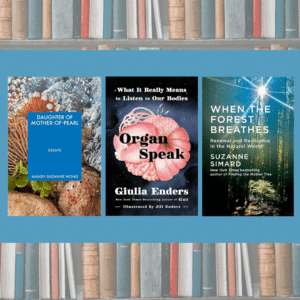
Daughter of Mother-of-Pearl by Mandy-Suzanne Wong
If I were to distill the lesson of novelist Mandy-Suzanne Wong’s essay collection Daughter of Mother-of-Pearl into a single sentence, that sentence would be: snails are someones, too! The same goes for crabs, jellyfish, starfish, oysters, mussels—Wong excludes no one, no matter how eyeless or slimy. Her essays on undersea invertebrates operate as experiments in empathy, striving towards an alert and open-hearted attunement to creatures whose ways of being can seem so alien, from our limited terrestrial mammalian perspective, that we reject their beinghood out of hand. Wong repudiates the arrogance that underlies this dismissal, along with the accusations of “anthropomorphism” that those afflicted by it tend to level at efforts to imaginatively honor other animals’ inner lives. It is vulgar, she writes, “to think that everybody’s feelings must be intelligible to oneself in order to exist or qualify as feelings.” Against this crude habit of mind, Wong challenges readers to let themselves be humbled before the shimmering, spiraling polymorphic strangeness of other lives, and the marvel it is to share the earth with myriad precious and mysterious someones.
For fans of My Octopus Teacher, Elisabeth Tova Bailey’s The Sound of a Wild Snail Eating, and those looking for motivation to keep expanding their own personal circle of care.
Organ Speak: What It Really Means to Listen to Our Bodies by Giulia Enders
When people talk about “body positivity,” they typically mean something rather superficial. When they tell you to “love your body,” they’re hoping you will cultivate a healthy appreciation for your physical appearance, your shape and contours. They do not expect, for example, that you’ll develop an affectionate intimacy with your spleen. But Giulia Enders, a German physician and the author of Gut: The Inside Story of Our Body’s Most Underrated Organ (2014), champions the latter sort of body positivity, increasingly hard to imagine as our days swarm lousy and lousier with screens and memes, AI hallucinations and spambot promises of machine-mediated “optimization.” Upon realizing how many of her patients were frustrated with their bodies for not “functioning like machines” or “looking like dolls,” Enders felt called to write Organ Speak as an intervention on the side of the flesh. She saw that, too often, people’s bodies were experienced by them as a source of chronic dissatisfaction, viewed with distrust, even hostility. Which seemed a shame, she thought, for the human body is truly a wonder. Each chapter of Organ Speak spotlights a different bodily structure or system – lungs, skin, muscles, immune system, brain – to resuscitate a due reverence for the intricate and interconnected workings of these vital parts. Enders sees the human body as a kind of microcosm for the biospheric “superorganism” and proposes that, by contemplating the viscera that compose us, we can glean insights for how to conduct ourselves in our own role as the constituents of an interdependent whole, members of communities both human and larger-than-human.
For explorers of that weird misted mystic realm where biology and philosophy cross paths.
When the Forest Breathes: Renewal and Resilience in the Natural World by Suzanne Simard
Suzanne Simard is forest ecology’s answer to Jane Goodall, celebrated for her pioneering research into the arboreal relationships facilitated by the “wood wide web,” the twining of hair-like fungal hyphae that sprawls beneath the forest floor, stitching trees and other plants together in a vast interwoven lace. Without these networks, and the communication and collaboration they make possible, there would be no forests; these complex ecosystems could not survive. Such was the subject of Simard’s previous book, Finding the Mother Tree, and though she dips into that fertile ground again in her latest work, her present focus takes us treading onto unhappier territory: the stricken barrens left behind by the logging industry. In When the Forest Breathes, Simard writes about her research into the desolation wrought by clearcutting, which undermines forests’ regenerative potential, as well as her years of activism as she worked alongside scientists, environmentalists, and indigenous communities to stop this injurious practice. Yet the book is by no means a cheerless read, for as sorrowfully as she grieves the damage done, and as fierce as she is in her disgust for the corporate greed behind the ongoing destruction, no extremity of despair or horror can dampen the radiance of Simard’s awe for forest worlds, for the rich congregation of lives that compose them: the lichens, moss, ferns, spiders, squirrels, bears, and, of course, the trees, like spires questing into earth and sky in one breath, greening the light.
For fans of forests, woodlands, glades, thickets, and copses.